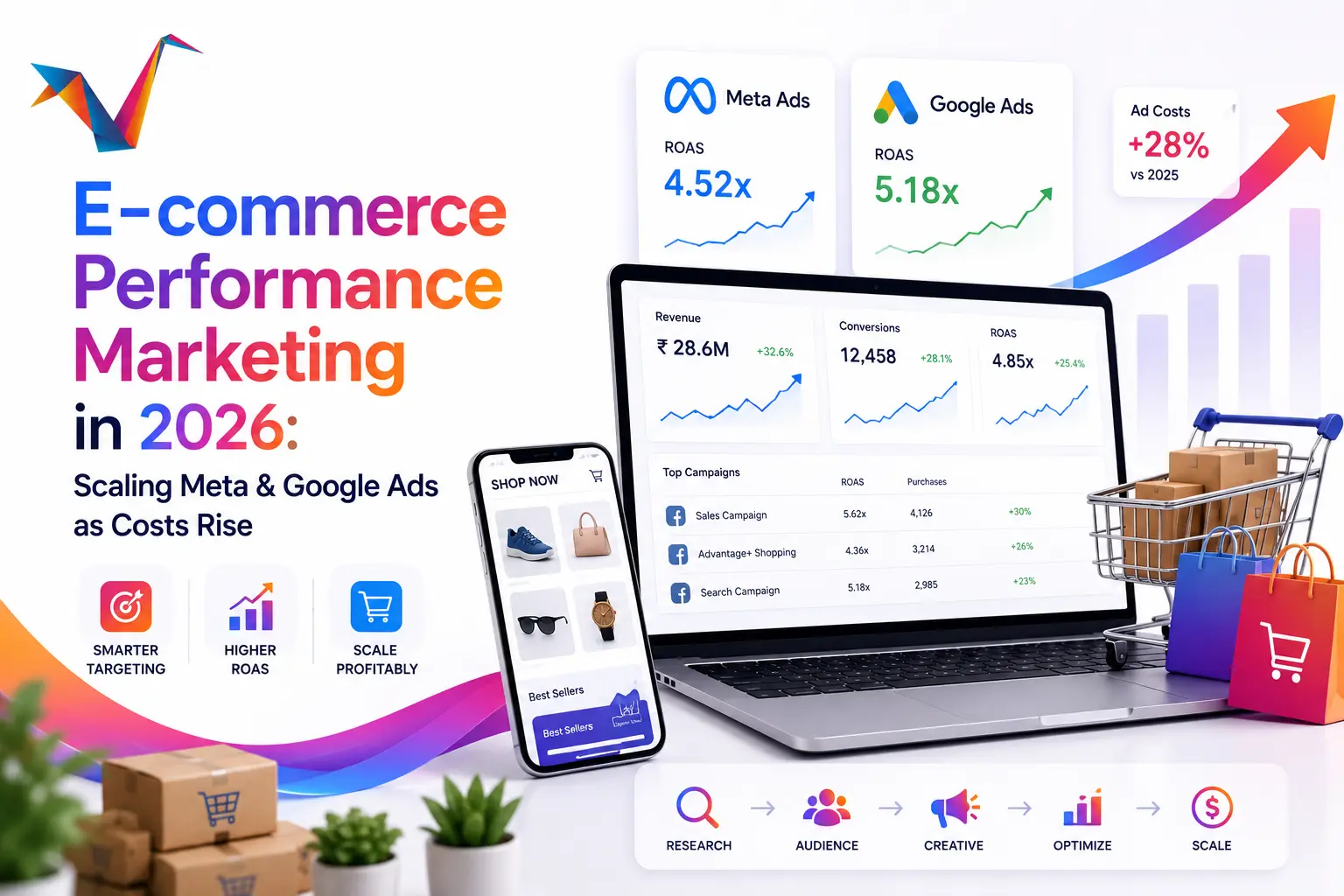
Rising CPMs and CPCs across Meta and Google Ads mean e-commerce brands can no longer scale by simply increasing budgets. In 2026, sustainable growth depends on first-party data activation, creative velocity, retention-driven LTV, and diversifying acquisition beyond the two ad duopolies. Brands that pair paid media with strong organic and AI-search visibility are seeing the lowest blended CAC.
If you've watched your cost-per-click creep up quarter after quarter while conversion rates stay flat, you're not imagining it. Auction competition on both Meta and Google has intensified as more D2C and marketplace sellers pile into the same audiences, and privacy-driven signal loss has made targeting less efficient than it was three years ago. The brands still growing profitably in 2026 aren't spending more — they're spending smarter, across more channels, with a tighter link between paid acquisition and what happens after the click.
Why Are Meta and Google Ads Getting More Expensive in 2026?
Three forces are compounding at once:
- Auction saturation: More advertisers are competing for the same finite inventory, especially in high-intent Google Shopping and Meta Advantage+ placements.
- Signal degradation: Cookie deprecation and app tracking restrictions have reduced the precision of lookalike and remarketing audiences, pushing platforms toward broader, more expensive automated targeting.
- AI-driven bidding opacity: Both platforms now push advertisers toward automated campaign types (Performance Max, Advantage+ Shopping) where manual levers are limited, making it harder to control efficiency at scale.
The result: blended CAC is rising even for brands with strong creative and solid conversion rates. The fix isn't a single tactic — it's a structural shift in how acquisition budgets are allocated. If you're not sure where your budget is leaking, a performance marketing audit is the fastest way to find out.
How to Scale Meta Ads Profitably When Costs Rise
1. Feed first-party data back into the algorithm
Conversions API (CAPI) implementation is no longer optional. Brands that pass complete, deduplicated server-side event data to Meta consistently see better optimization than those relying solely on the pixel. Match quality — email, phone, and purchase value passed accurately — directly affects how efficiently Advantage+ campaigns find buyers.
2. Increase creative velocity, not just spend
Meta's algorithm rewards fresh creative. Static campaigns fatigue faster in a competitive auction. Winning accounts in 2026 are running structured creative testing — multiple hooks, formats (UGC, static, short-form video), and offers — refreshed on a two-to-three week cadence rather than letting one "winning ad" run until it collapses.
3. Segment by funnel stage, not just audience type
Broad targeting works for prospecting, but retention and repeat-purchase campaigns need dedicated budgets and creative that speaks to existing customers differently than cold traffic. Blending these into one campaign structure is a common reason blended ROAS looks worse than it should. Our Meta Ads management services build this segmentation in from the start.
How to Scale Google Ads Profitably When Costs Rise
1. Structure Performance Max with intent, not just feed quality
PMax rewards a clean, well-segmented product feed with strong titles, custom labels, and accurate categorization — but feed quality alone won't offset rising CPCs. Asset group segmentation by margin tier and search intent gives the algorithm clearer signals about which conversions actually matter to the business.
2. Protect brand and high-intent terms with dedicated Search campaigns
Relying entirely on PMax can mean losing visibility and control over branded and bottom-funnel search terms. Running parallel Search campaigns for these high-converting queries, with negative keyword hygiene, keeps CPCs in check where competitors would otherwise inflate the auction.
3. Use value-based bidding tied to real margin, not just revenue
Optimizing toward total order value without accounting for margin or return rate leads to spending efficiently on the wrong products. Passing profit-adjusted conversion values into Google's bidding models is one of the highest-leverage changes brands can make this year. See how we approach this in our Google Ads management offering.
Diversifying Beyond Meta and Google in 2026
The brands with the healthiest blended CAC aren't abandoning Meta and Google — they're reducing dependency on them. A few channels earning renewed attention:
- Retention marketing (email, SMS, WhatsApp): Driving repeat purchase from existing customers costs a fraction of new-customer acquisition and directly improves LTV, which makes paid CAC easier to justify. Explore our retention marketing services.
- AI search visibility (GEO/AEO): As shoppers increasingly research products through AI assistants and AI Overviews before ever opening Meta or Google Ads, brands optimized for AI-generated answers are capturing discovery traffic competitors are missing entirely. Learn more about AI search optimization.
- Influencer and affiliate partnerships: Lower-cost, trust-driven acquisition that also feeds creative assets back into paid campaigns.
This is where paid media and organic/GEO strategy need to work together rather than sit in separate silos. A brand with strong AI search visibility and organic authority typically sees lower CPCs on branded search and better Quality Score across the board — because the platform's own signals reward sites that are already trusted elsewhere.
A Practical Framework for 2026 Budget Allocation
- Audit blended CAC by channel — not just platform-reported ROAS, which overstates performance due to attribution overlap.
- Fix data infrastructure first — CAPI, server-side tracking, and clean feed data before increasing spend.
- Rebalance budget toward retention — a 70/30 or 60/40 split favoring acquisition is often inverted from what LTV data actually supports.
- Invest in creative production capacity — treat it as an always-on function, not a monthly deliverable.
- Build organic and AI-search visibility in parallel — so paid spend isn't carrying 100% of the discovery burden.
Frequently Asked Questions
Is Meta or Google Ads more cost-effective for e-commerce in 2026?
Neither is universally cheaper — it depends on product category and purchase intent. Google typically wins for high-intent, search-driven categories, while Meta performs better for visually-driven or impulse categories. Most scaling brands run both, sized according to where their category's buying journey actually starts.
What is the biggest mistake e-commerce brands make when ad costs rise?
Cutting creative testing and retention spend to protect prospecting budgets. This usually accelerates the problem — fatigued creative and weak repeat-purchase rates push CAC even higher.
How does AI search visibility affect paid ad performance?
Brands that show up in AI-generated answers and AI Overviews build pre-purchase familiarity before a shopper ever sees a paid ad, which tends to lower CPCs on branded terms and improve click-through and conversion rates on paid campaigns for the same audience.