At some point, almost every growing business faces the same question.
You're spending real time on social media — or not spending enough, which is its own problem. The content is inconsistent. Results are unclear. Someone on the team is handling it alongside three other responsibilities. And every month that passes without a real strategy feels like a missed opportunity.
The question becomes: do we build this capability in-house, or do we hand it to someone who does this for a living?
That's the outsourcing decision. And in 2026, it's more nuanced than a simple yes or no — because the platforms have changed, the production requirements have intensified, and the options for how you outsource have multiplied.
This guide walks through everything — the real pros, the real cons, the honest costs, and the framework for doing it well if you decide to go that route.
1. What Outsourcing Social Media Marketing Actually Means
Outsourcing social media marketing means delegating some or all of your brand's social media function to an external party — a freelancer, a specialist agency, or a full-service growth partner.
"Some or all" is the important phrase. Outsourcing exists on a spectrum:
- Partial outsourcing — You keep strategy and brand direction in-house but outsource execution: content creation, video production, scheduling, or paid ad management.
- Full outsourcing — An external team handles everything: strategy, content, community management, paid advertising, reporting, and optimisation. Your internal involvement is approval and direction.
- Hybrid outsourcing — An internal hire (social media manager or marketing manager) runs strategy and brand voice, while an agency handles production, paid media, or specific platforms.
Most businesses that "outsource their social media" are actually somewhere on this spectrum rather than at either extreme. Understanding where you want to sit on it before you start looking is the first step to outsourcing well.
2. The State of Outsourcing in 2026 — Why This Decision Has Changed
Three things have changed the outsourcing calculus significantly since 2022:
- Short-form video is now non-negotiable — Reels, Shorts, and TikTok-format content dominate discovery on every major platform. Producing this consistently and at quality requires a dedicated workflow — scripting, shooting, editing, sound design, captioning. It's not something a single in-house generalist can absorb into an already full job.
- AI-generated content has raised audience scepticism — Ironically, the proliferation of AI tools has made authenticity more valuable, not less. Audiences in 2026 are sharp at detecting templated, AI-generated content — and they discount it accordingly.
- Platform complexity has increased — Meta's Advantage+ system, LinkedIn's algorithm evolution, YouTube's recommendation mechanics, and the ongoing fragmentation of attention across platforms have made platform expertise a genuine specialist skill.
These three factors have made the case for outsourcing stronger in 2026 than it was in 2020 — but they've also raised the bar for what quality outsourcing looks like.
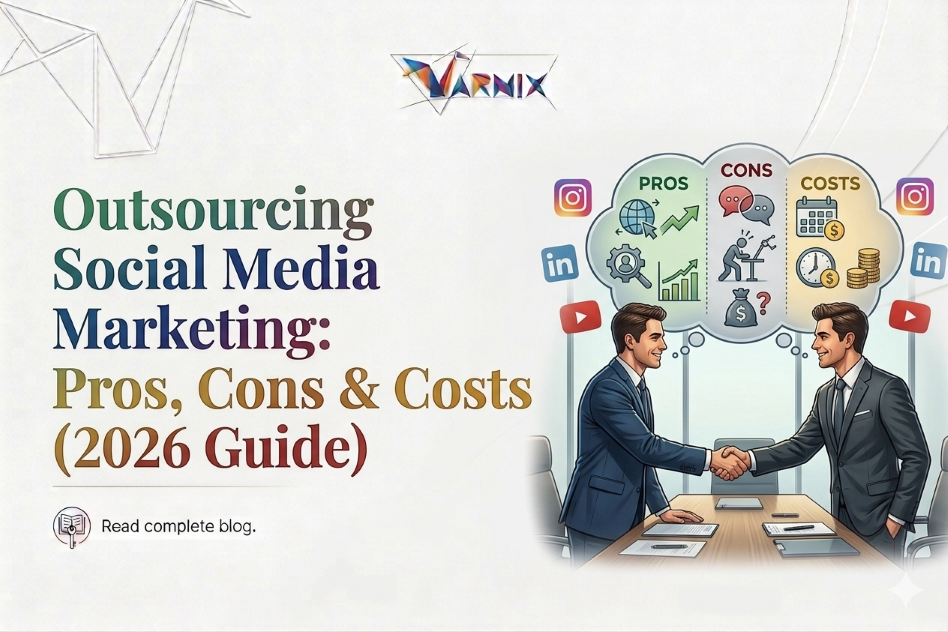
3. The Pros of Outsourcing Social Media Marketing
- You get a team, not a task — The structural advantage of outsourcing is that you access a full team — strategist, designer, copywriter, video editor, media buyer, analyst — for the cost of a single mid-level hire.
- Immediate expertise, no learning curve — An experienced agency has already made the expensive mistakes — on other people's accounts. You get that pattern recognition from day one rather than spending months developing it yourself.
- Consistency without internal dependency — Social media dies when it becomes dependent on one person's bandwidth. An agency absorbs the variability — team leaves, busy quarters, product launches — and keeps the output consistent.
- Access to professional tool stacks — A professional agency distributes the cost of a ₹50,000–₹1,00,000/month tool stack across multiple clients. You get the benefit without carrying that cost yourself.
- Faster iteration and optimisation — Agencies running multiple client accounts develop faster intuition for what works. This accelerates the testing and optimisation cycle — especially important for paid campaigns where slow iteration is a direct budget cost.
- Scalability on demand — Adding a new platform, scaling ad spend, launching a campaign for a new product — an agency absorbs these scope expansions without the delays and costs of recruiting and onboarding new internal hires.
- An outside perspective on your brand — Agencies bring fresh eyes, honest reactions, and platform knowledge that internal teams — who know too much and are too close — often can't provide.
4. The Cons of Outsourcing Social Media Marketing
- Brand knowledge takes time to transfer — No agency walks in on day one knowing your brand as well as your internal team does. The onboarding process takes weeks, not days. Early content often feels slightly off.
- You lose direct control over day-to-day output — With an agency, there are communication protocols, approval workflows, and turnaround times. If something needs to change quickly, the response speed of an external team is structurally slower than an internal one.
- Authentic content requires your participation — Thought leadership posts, behind-the-scenes content, and founder-voice content require raw material from you. Brands that expect full outsourcing to be entirely hands-off consistently underperform.
- You're one of multiple clients — Your brand is the most important brand to you. It is one of many to your agency. Even excellent agencies have to manage their attention across a portfolio.
- Cost without ROI clarity can feel hard to justify — Social media's impact on revenue is often indirect and attribution is genuinely difficult. In a slow month, a ₹70,000 retainer can feel unjustifiable to leadership.
- Risk of template-based, interchangeable content — Some agencies, particularly at lower price points, produce content that could belong to any brand — same formats, same copy structures rotated with different logos.
5. Outsourcing vs. In-House vs. Hybrid — Full Comparison
- Cost structure — Outsourced: Monthly retainer, variable by scope. In-House: Salaries, tools, benefits — fixed overhead. Hybrid: Combined — internal salary + agency scope.
- Team breadth — Outsourced: Full team (strategy to execution). In-House: Limited to headcount. Hybrid: Best of both — internal brand knowledge + external specialist skills.
- Brand knowledge — Outsourced: Builds over time with investment. In-House: Deep from day one. Hybrid: Strong — internal lead maintains brand context.
- Speed of response — Outsourced: Structured (approval workflows). In-House: Immediate. Hybrid: Internal handles real-time; agency handles production.
- Consistency — Outsourced: High — agency absorbs variability. In-House: Depends on individual. Hybrid: High — agency covers production gaps.
- Scalability — Outsourced: High — add scope without hiring. In-House: Low — requires recruitment. Hybrid: Medium — internal bottleneck at strategy level.
- Best for — Outsourced: SMEs, brands without marketing teams, growth-phase brands. In-House: Mature brands with large marketing budgets and complex needs. Hybrid: Brands with a strong internal marketing lead needing execution capacity.
6. What Does Outsourcing Actually Cost in 2026?
- Outsourcing to a freelancer — Cost: ₹8,000 – ₹30,000/month. What you get: Execution support in their area of expertise. Limited strategic depth. Best for: Early-stage brands, very limited budgets.
- Outsourcing to a boutique agency — Cost: ₹25,000 – ₹70,000/month. What you get: Strategy, content creation, community management, basic reporting for 2 platforms. Best for: Growing SMEs, D2C brands.
- Outsourcing to a mid-size full-service agency — Cost: ₹60,000 – ₹2,00,000/month. What you get: Full-service management, video production, paid advertising, influencer coordination. Best for: Established brands with clear commercial targets.
- Outsourcing to a full-spectrum growth agency — Cost: ₹1,50,000 – ₹8,00,000+/month. What you get: Integrated growth strategy across all digital channels, high-quality production, senior team involvement. Best for: Large consumer brands, national campaigns.
Additional costs to budget separately:
- Ad spend: ₹15,000 – ₹5,00,000+/month (goes directly to platforms, separate from agency fees)
- Influencer fees: ₹5,000 – ₹10,00,000+ per collaboration (separate from management fees)
- Production shoots: ₹10,000 – ₹5,00,000+ (if not covered in retainer)
- Tool pass-throughs: ₹3,000 – ₹20,000/month (if billed separately by agency)
7. What You Should Never Fully Outsource
Some things genuinely cannot be outsourced without significant cost to brand quality.
- Brand point of view and authentic expertise — Your category knowledge, your founder's perspective, your team's experience — this is intellectual property that no agency can replicate. The raw material has to come from you.
- Real-time crisis response — When something goes wrong, response time is measured in minutes, not working days. Your internal team needs to own the first response to any reputational crisis.
- Internal culture and behind-the-scenes content — Authentic workplace content, team stories, founder moments require genuine access. The content originates inside your organisation.
- Final brand approval — Every piece of content that goes out under your brand name should have a human inside your business who has reviewed and approved it.
- The relationship with your audience — When key customers, partners, or community members reach out meaningfully, those interactions benefit from genuine human connection on your side.
8. How to Outsource Well — The Framework That Works
- Define outcomes, not just activities — Don't brief an agency with "post 15 times a month and manage comments." Brief them with "generate 40 qualified leads per month from LinkedIn" or "build a following of 25,000 engaged followers in your target demographic within 12 months."
- Invest seriously in onboarding — The first month is not about content. It's about brand transfer. Give your agency everything: brand guidelines, competitor positioning, customer research, past content performance data.
- Establish a real content approval process — Define: who reviews content, what the turnaround time for approvals is, and how urgent changes are handled. Slow approval processes are the single most common reason agency content quality deteriorates.
- Have a single internal owner — Someone inside your business needs to own the agency relationship. Not a committee. One person who is the decision-maker, the approver, and the escalation point.
- Schedule regular strategy conversations, not just reporting calls — Monthly reporting calls that only look backwards are not enough. Quarterly strategy conversations keep the agency ahead of your needs.
- Give feedback specifically and promptly — "This doesn't feel right" is not actionable feedback. "This caption sounds too formal — our audience is early-stage founders who prefer direct, conversational language" is.
9. The Most Common Outsourcing Mistakes (And How to Avoid Them)
- Mistake 1: Treating it as completely hands-off — The best outsourcing arrangements are collaborative — the agency brings execution excellence, you bring brand depth and direction. Brands that go fully hands-off get generic content that nobody engages with.
- Mistake 2: Evaluating too early — Set a 3-month minimum evaluation period. Month-by-month assessment of social media is like weighing yourself every hour — the noise obscures the signal.
- Mistake 3: Misaligned expectations on deliverables vs. outcomes — Be clear about what you're holding the agency accountable for: the quality and consistency of their work, the improvement trend of their KPIs, and the intelligence of their recommendations.
- Mistake 4: Choosing on price alone — The cheapest option for social media management almost always delivers the cheapest-looking output. The relevant question is not "what is the cheapest option?" but "what is the minimum investment that delivers the quality our brand requires?"
- Mistake 5: Not defining who owns what — Ambiguity about roles causes friction. Define ownership of every function before the retainer starts, and document it.
- Mistake 6: Neglecting the data — You should know your core metrics, be able to read a basic analytics dashboard, and have an informed view on what's working.
10. Signs Your Outsourcing Arrangement Isn't Working
- Content looks good but engagement is consistently low — audiences are scrolling past rather than stopping
- The agency only contacts you when they need approvals — no proactive ideas or strategic updates in between
- Monthly reports show the same numbers with no meaningful trend improvement after six months
- The team on your account has changed without any conversation with you
- You're getting execution but no strategic thinking — the brief you gave at the start is being executed mechanically rather than evolved
- Your brand voice in social content doesn't match how your team actually communicates
- The agency is defensive about performance data rather than analytical
11. Signs It's Working Exactly as It Should
- Content quality is improving month on month and the agency is raising the creative bar without being asked
- They bring ideas you hadn't thought of — platform trends, competitor observations, content angles specific to your brand
- KPIs are moving in the right direction even if absolute numbers are still building
- They tell you when something isn't working and why, rather than presenting everything positively
- Your internal team has more time for strategic work because execution is reliably covered
- You feel genuinely represented on social media — the content sounds and feels like your brand
- They push back on your direction when they have a well-reasoned alternative view
- Reporting connects content activity to business outcomes in a way you can explain to leadership
When to Switch From Outsourced to In-House
Outsourcing is not the permanent answer for every brand at every stage. Here are the signals that it's time to build internal capability:
- Social media is your primary acquisition channel and it's working at scale — The break-even point typically sits when total outsourcing costs exceed ₹2,00,000–₹3,00,000/month consistently.
- Your brand requires deeply authentic, real-time content — Some brands need someone embedded in the business full time. An external team structurally can't provide the access those content strategies require.
- You've outgrown your agency's capability — Growth-stage brands sometimes scale faster than their agencies. If your brand's needs have matured beyond what your current agency can deliver, it's time to consider building internal senior capability.
- You want tighter control over brand voice at high volume — At significant content volume across many platforms, some brands bring core content and strategy in-house while continuing to outsource production and paid media.
The Hybrid Model — The Best of Both Worlds
In 2026, the hybrid model has emerged as the most effective structure for the majority of growth-phase Indian brands.
What the hybrid model looks like: One internal hire — typically a social media manager or marketing manager — owns brand voice, content strategy, and the agency relationship. An external agency handles production (especially video), paid media management, influencer coordination, and potentially additional platforms or campaign execution.
The role split that works best:
Internal owns:
- Brand strategy and content direction
- Content approvals and brand voice
- Community relationships with key accounts and influencers
- Real-time response and crisis management
- The agency relationship and brief management
Agency owns:
- Content production at scale (especially video)
- Paid social campaign management
- Analytics infrastructure and reporting
- Platform expertise and algorithm knowledge
- Influencer identification and campaign management
The cost reality: An internal mid-level social media hire in India in 2026: ₹4,00,000 – ₹8,00,000/year (₹33,000 – ₹67,000/month equivalent). A focused agency scope covering production and paid media: ₹40,000 – ₹80,000/month. Total hybrid investment: ₹73,000 – ₹1,47,000/month — for a capability that rivals a full in-house team of three or four people.
For brands at ₹5 crore+ in annual revenue with serious social media ambitions, the hybrid model consistently outperforms both fully outsourced and fully in-house at equivalent spend.
Looking to Outsource to the Right Partner? Meet Varnix
Varnix is built precisely for the outsourcing model that works in 2026: strategy-first, full-team execution, in-house production, and commercial accountability.
- They start with strategy, not content — Every engagement begins with a deep brand strategy phase — audience mapping, platform selection, content pillars, tone of voice, and KPI framework.
- Full team on your account — Strategists, designers, video producers, copywriters, and media buyers — working on your brand simultaneously. Not a single account manager stretched across forty clients.
- In-house video production — Reels, Shorts, brand films, ad films, motion graphics, cinematic edits — all produced in-house. The production quality that short-form video demands in 2026, without the delays of external vendor dependency.
- Performance Marketing with real accountability — Meta Ads, Google PPC, YouTube Ads — full funnel architecture, pixel tracking, segmentation, retargeting, and A/B testing. Every rupee of ad spend tracked to an outcome.
- Transparent, honest commercial terms — No hidden costs. No opaque deliverables. No lock-in surprises. Assets stay yours. Scope is agreed upfront, in writing, before work begins.
- Proven across categories — Sports franchises, F&B brands, real estate developers, lifestyle brands, event marketing — Varnix has built social media presence and driven commercial results across genuinely diverse categories.
Whether you're outsourcing for the first time, replacing an arrangement that isn't working, or building the agency side of a hybrid model — start with a strategy conversation.
Book a free strategy consultation with Varnix — contact
The Takeaway
Outsourcing social media marketing in 2026 is not a shortcut. It's a strategic decision about how you build capability — and like every strategic decision, the quality of the outcome depends on the quality of the thinking that goes into it.
Done well — with clear goals, the right partner, genuine internal involvement, and a realistic timeline — outsourcing is one of the highest-leverage moves a growing brand can make. Done poorly — with vague briefs, cheap execution, and no strategic oversight — it's an expensive way to produce content nobody engages with.
The right partner makes all the difference.
Frequently Asked Questions
Is outsourcing social media marketing a good idea for small businesses?
Yes — with the right expectations. For small businesses without a dedicated marketing team, outsourcing gives access to specialist skills and consistent execution that would be impossible to replicate in-house at the same cost. The key is choosing an agency appropriate to your scale and being genuinely involved in the brand direction side.
What is the biggest risk of outsourcing social media?
The biggest risk is generic content — work that looks like it could belong to any brand and therefore builds nothing distinctive. This is mitigated by thorough agency vetting, rigorous onboarding, specific creative briefs, and ongoing directional involvement from your side.
How involved do I need to be if I outsource my social media?
More involved than most people expect. Expect to spend 2–4 hours per week on approvals, feedback, and strategic direction — especially in the first three months. As the agency learns your brand, this typically reduces to 1–2 hours per week.
Can I outsource just the paid advertising and keep organic in-house?
Yes — and this is actually a common and sensible split. Paid social is a highly specialist skill where agency expertise typically delivers meaningfully better ROAS than in-house management. Organic content benefits from internal brand knowledge. Splitting these responsibilities works well with clear role definition.
How long should I give an outsourcing arrangement before evaluating it?
Three months minimum for organic social. Six months for a full evaluation including paid campaign performance. For paid campaigns, the first 4–6 weeks are typically learning and optimisation — results in weeks 1–3 are not representative of mature campaign performance.
What happens to my social media accounts if I end the outsourcing relationship?
You should retain full owner-level access to all social media and ad accounts at all times — this is non-negotiable and should be in your contract. All creative assets produced during the engagement should transfer to your ownership on payment of fees.
How do I brief an agency effectively when outsourcing for the first time?
The most effective briefs cover: your specific business goal, your target audience (with as much detail as you have), your brand voice (what does it sound like? What does it not sound like?), examples of content you admire, your competitive landscape, and your past social media performance data.
Does Varnix work well as a hybrid model partner?
Yes — Varnix regularly operates as the agency side of a hybrid model, working alongside internal marketing teams. They're structured to integrate with internal stakeholders, adapt to existing brand guidelines, and fill the production and paid media gaps that in-house teams typically can't cover alone. Start the conversation here.